People often ignore the fine knob. It’s small, unassuming, and sits there like the shy friend at a party. But once you know how it works, you realize it’s the soul of the microscope.
Think of it like focusing a camera on a flower petal. The big knob gets you close—say, within a foot of the flower. But the fine knob? That’s the whisper that brings the dewdrop on the petal into perfect, crystal clarity. It’s the difference between “I see something green” and “Wow, that cell has a tiny, angry-looking nucleus.”
In daily life, it’s like tuning an old radio. The big knob finds the station, but the fine knob gets rid of the static so you can hear the song. Without it, you’re just listening to noise.
How to Befriend It
Start by using it only after you’ve done the “heavy lifting” with the coarse knob. Get your sample roughly in view—a little blurry is fine. Then, stop. Take a breath.
Now, touch the fine knob. It usually turns in tiny, smooth clicks. Turn it just a hair clockwise. Does it get sharper? Good. Turn it a hair more. Do not rush. This is not a race. It’s a slow dance with a tiny universe.
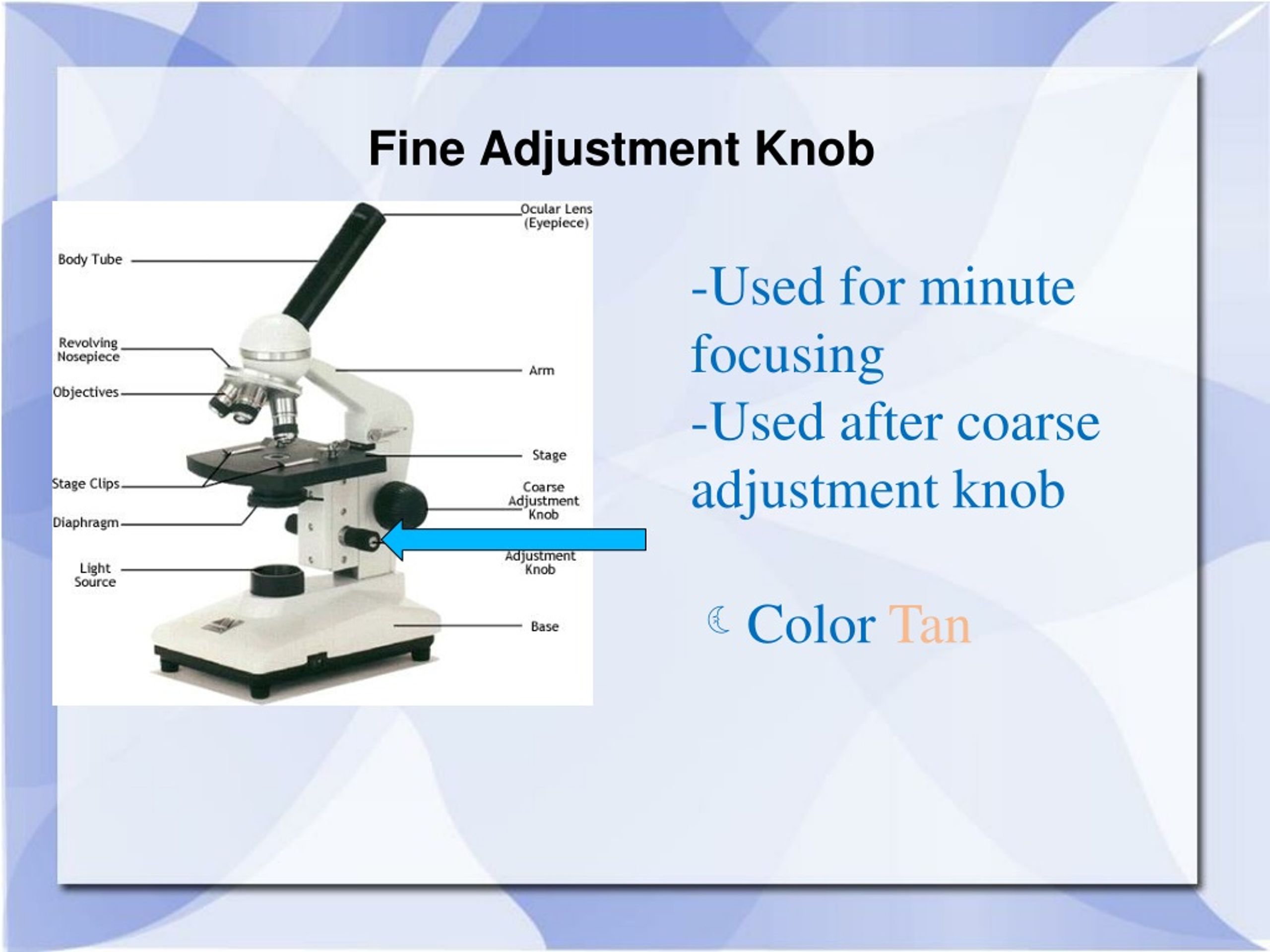 PPT - Microscope PowerPoint Presentation, free download - ID:9173366
I once spent five minutes just watching a single cheek cell come into focus. It started as a smudge, then—pop—I saw the nucleus, like a tiny grape in the middle of a wobbly balloon. That moment only happened because I trusted the fine knob.