First, let’s talk about the hardware. A plug-in solar kit usually has a solar panel (or two), a micro-inverter, and a very special cable that ends in a regular, three-prong plug. You literally stick the panel on your balcony, in a window, or on your lawn like a weird, rectangular plant.
Then, you run the cord inside and plug it into any standard wall outlet. Boom. You’re officially a tiny, part-time power plant owner. No electrician, no roof drilling, no getting yelled at by your homeowners' association.
The real magic happens inside that little box called the micro-inverter. This is the unsung hero, the behind-the-scenes wizard of the operation. It’s the size of a thick paperback book, but it does the heavy lifting.
Your Outlet is a Two-Way Street (Who Knew?)
Here’s the surprising fact that will make you sound smart at parties: your household power outlets aren't just for sucking electricity into your gadgets. They’re actually connected to a giant, city-wide electrical grid. Electricity flows both ways, like a very serious, high-voltage highway.
When your solar panel is soaking up photons (sunlight), the micro-inverter turns that raw, chaotic Direct Current (DC) into the smooth, alternating current (AC) your house uses. But here’s the kicker: it has to perfectly match the voltage and frequency of the grid.
Think of it like a singer joining a choir. If you sing off-key, everyone groans. If your panel sends wonky electricity, the grid throws a fit (and so do your circuit breakers). So the micro-inverter constantly listens to the grid’s "note" and sings the exact same one, pushing your solar power out through the plug.
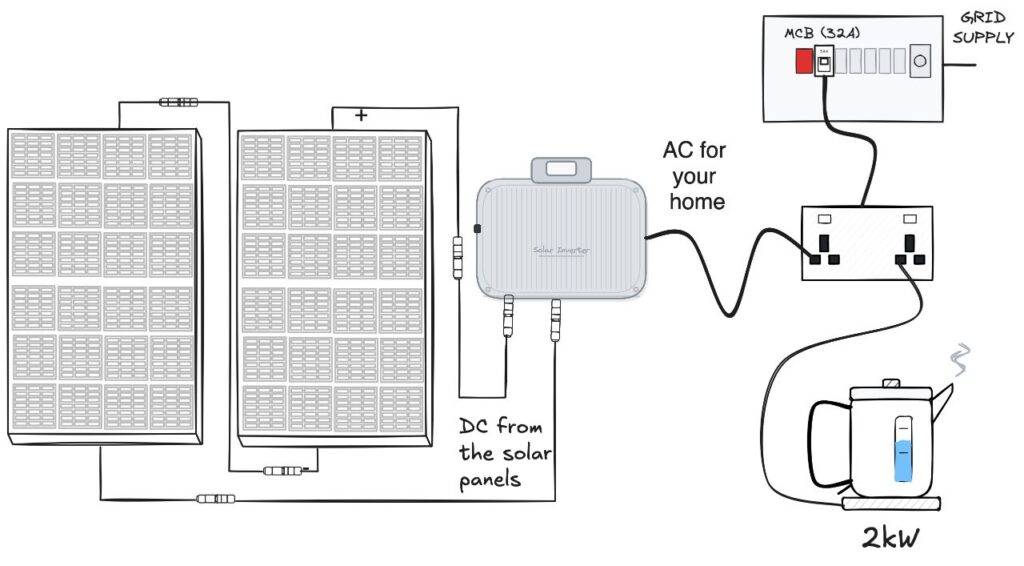 Plug-in Solar Panels UK: Rules, Limits & Dates (2026)
It’s like the panel is a tiny, green-blooded spy injecting its clean energy into the main power line of your house. Your refrigerator has no idea it’s getting power from a window panel. It just knows the lights are on.