
How To Solve Sudoku Advanced Techniques
Alright, grab your coffee. Let’s talk about those Sudoku puzzles that taunt you from the back of the newspaper. You know the ones—the ones labeled “Hard” or “Expert” where you...
Alright, grab your coffee. Let’s talk about those Sudoku puzzles that taunt you from the back of the newspaper. You know the ones—the ones labeled “Hard” or “Expert” where you feel like you need a math degree and a lucky charm. I’m here to tell you that you absolutely don’t. You just need a few sneaky advanced tricks.
First, let’s be real. You’ve already mastered the basics: scanning rows and columns, looking for forced numbers. That’s like knowing how to boil water. Now we’re making a soufflé. It’s the same ingredients, but the technique gets weird—and fun.
Ready for the first secret weapon? It’s called Naked Pairs. Sounds scandalous, right? It’s not. Imagine two cells in the same row that only contain the same two numbers between them, like a 3 and a 7. Those two numbers are locked in that pair. You can instantly erase 3 and 7 from every other cell in that row. Boom. The puzzle just got a little less crowded.
Now let’s flip it around. Meet the Hidden Pair. This one’s shy. You have a row, and two specific numbers only appear in two cells. They’re hiding among a bunch of other candidates. Circle those two numbers. They can’t go anywhere else. That means you can safely remove all the other candidate numbers from those two special cells. It’s like finding a secret handshake in a noisy room.
But wait—what if you have three numbers in three cells? That’s a Naked Triple. Yes, we’re moving up the food chain. If three cells in a house (that’s a row, column, or box) share the same three candidates, those three numbers are locked. Kick them out of all other cells in that house. It feels like a tiny rebellion against chaos.
Here’s the part where people start sweating: X-Wing. Please don’t run. It’s not a Star Wars reference. An X-Wing happens when a specific number appears in only two rows and exactly two columns, forming a rectangle. Imagine a number, say 4, that’s only possible in row 1 at columns A and D, and also only in row 5 at columns A and D. Those four corners are the X-Wing. Now you can remove that number from all other cells in those columns. It’s like a chess move for your brain.
Feeling brave? Let’s talk Swordfish. Sounds cooler than it is. A Swordfish is just a bigger, lazier X-Wing. It uses three rows and three columns instead of two. If the number 2 appears in only three possible rows across the same three columns, you can zap it from the rest of those columns. Honestly, you might only use this once a month. But when you do, you’ll feel like a wizard.
Now, for the trickiest one: Forcing Chains. This is not for the faint of heart. You pick a cell with two possible numbers. You say, “If this is a 5, then that cell over there becomes a 9, and then this one becomes a 3, and that leads to a contradiction.” Wait, there’s a contradiction? Great! That means your first guess was wrong, so the other number must be right. It’s like solving a mystery by seeing which story falls apart first.
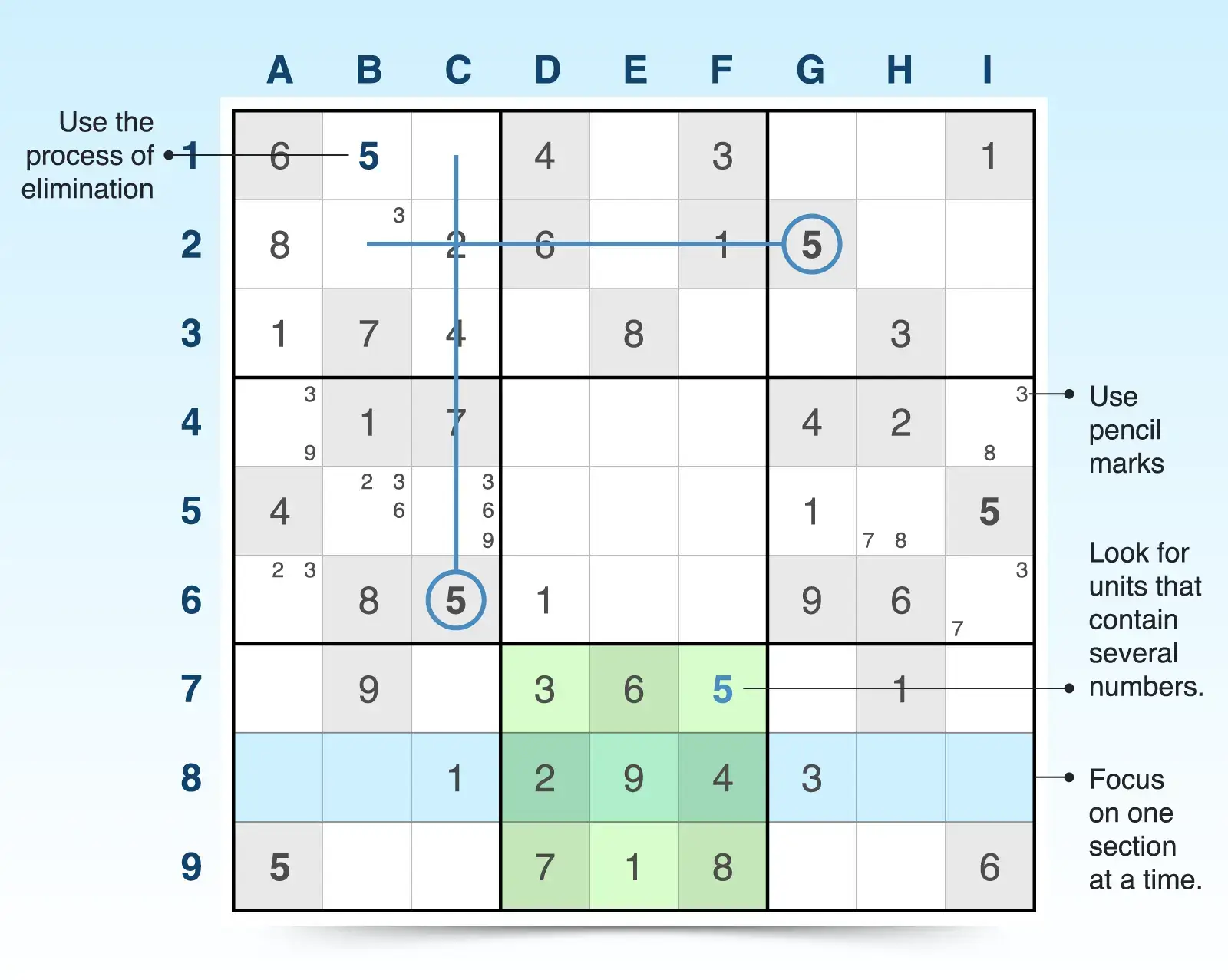 Difficult Sudoku Strategies
I should warn you: Forcing Chains can get messy. You might find yourself staring at a grid for ten minutes, mumbling like a conspiracy theorist. That’s normal. Take a sip of coffee. Come back fresh.
Before you dive in, remember the golden rule: Pencil marks are your friends. Use tiny numbers. Write possible candidates in each cell. It looks ugly, but it’s how you see the patterns. Think of it as scaffolding for your brain.
What if you hit a wall? Try Backtracking. That’s a fancy word for guessing and checking. Pick a cell with two options. Guess one. Solve as far as you can. If the puzzle breaks, you know that guess was wrong. Just erase your steps and pick the other number. It’s not cheating—it’s experimental logic.
One last tip: slow down. Advanced techniques aren’t about speed. They’re about noticing the quiet relationships between numbers. Sudoku is a conversation between squares. Listen closely.
So go ahead. Grab a coffee, pull up a hard puzzle, and give a Naked Pair a shot. You’ll mess up a few times. Who cares? Each mistake teaches you where the pattern isn’t. That’s still progress, my friend.
Now, if you’ll excuse me, I have a grid to conquer. And a second cup of coffee to drink. Happy solving.

